Quick Answer
Industrial HPHT diamond synthesis operates at 5–6 GPa and 1,300–1,600°C using Ni-Mn-Co catalyst alloys to dissolve graphite and precipitate diamond onto seed crystals. Growth rate, temperature gradient, and catalyst chemistry are the primary control variables that determine crystal quality, inclusion density, and color — with memorial diamonds requiring additional purification steps for biological carbon feedstock.
Laboratory-grown diamond manufacturing occupies a unique position at the intersection of materials science, thermodynamics, and precision engineering. Unlike conventional manufacturing processes where raw materials are shaped or assembled, diamond synthesis is a phase transformation: carbon atoms are rearranged from graphite into the diamond crystal structure under conditions that place the system within the diamond stability field of the carbon phase diagram. This article examines the materials science fundamentals that govern industrial HPHT diamond production, with specific attention to the process parameters, quality controls, and engineering constraints that define memorial diamond manufacturing.
TL;DR — Quick Summary
Industrial HPHT diamond synthesis operates at 5–6 GPa and 1,300–1,600°C using Ni-Mn-Co catalyst alloys to dissolve graphite and precipitate diamond onto seed crystals. Growth rate, temperature gradient, and catalyst chemistry are the primary control variables that determine crystal quality, inclusion density, and color — with memorial diamonds requiring additional purification steps for biological carbon feedstock.
Key Takeaway: Industrial HPHT diamond synthesis operates at 5-6 GPa and 1,300-1,600°C, using Ni-Mn-Co catalyst alloys to dissolve and transport carbon from graphite feedstock to a diamond seed crystal. Growth rate, temperature gradient, and catalyst chemistry are the primary control variables that determine crystal quality, inclusion density, and color characteristics. Memorial diamond manufacturing applies these same scientific principles to biological carbon feedstock after purification and graphitization.
The Carbon Phase Diagram: Thermodynamic Foundations
The production of synthetic diamonds is governed by the carbon phase diagram, which defines the pressure-temperature regions where graphite, diamond, and liquid carbon are thermodynamically stable. At ambient pressure and temperature, graphite is the stable allotrope. Diamond becomes the stable phase only above approximately 1.5 GPa at room temperature, with the stability boundary shifting to higher pressures as temperature increases.
The industrial significance of this phase diagram is straightforward: diamond synthesis requires generating conditions within the diamond stability field. For HPHT manufacturing, this means pressures above 5 GPa and temperatures above 1,300°C. The "diamond belt" — the narrow region between the diamond-graphite equilibrium line and the diamond-liquid carbon melting line — is where industrial synthesis operates. This region is approximately 1,300-1,600°C at 5-6 GPa.
The phase diagram also explains why diamond synthesis is not spontaneous even under correct conditions. The graphite-to-diamond transformation is reconstructive: carbon atoms must break existing bonds in the hexagonal graphite lattice and reform into the tetrahedral diamond lattice. This requires both thermodynamic driving force (the pressure-temperature conditions) and kinetic facilitation (the catalyst system). Without the catalyst, the activation energy barrier is too high for practical industrial timescales.
HPHT Synthesis Mechanics: Pressure Generation and Temperature Control
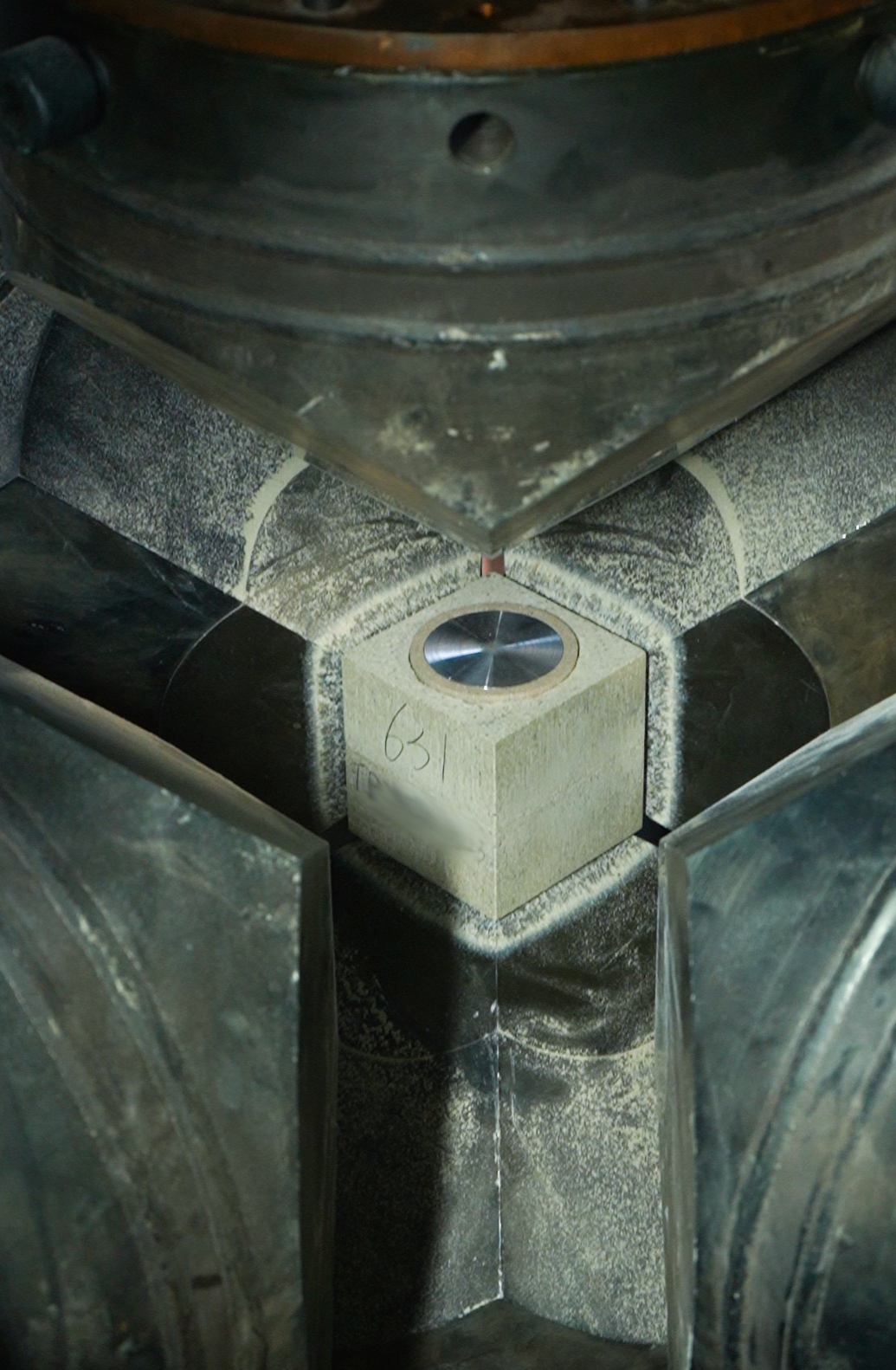
Industrial HPHT presses generate the required pressure through two primary mechanisms: the cubic press and the belt press. The cubic press, dominant in Chinese manufacturing, uses six anvils converging on a central cube-shaped volume. Each anvil is driven by a hydraulic ram, and the geometry produces quasi-hydrostatic pressure on the synthesis cell. Belt presses, more common in early Western synthetic diamond production, use two opposed anvils with a toroidal containment ring.
The synthesis cell — the capsule that contains the carbon feedstock, catalyst, and diamond seed — is a carefully engineered assembly. It typically consists of a pyrophyllite or ceramic pressure-transmitting medium, a graphite heater tube, a metal catalyst disc, and the carbon source. The cell must transmit pressure uniformly while maintaining electrical isolation for resistive heating. Cell design is a proprietary engineering discipline: the geometry of the heater, the placement of the seed crystal, and the distribution of carbon feedstock all affect temperature uniformity and growth consistency.
Temperature control within the synthesis cell is achieved through resistive heating of the graphite tube. The heating current is regulated to maintain the target temperature within ±10°C, which is critical for growth rate stability. Temperature gradients across the cell are intentional: the seed crystal is placed at the cooler end, while the carbon source (graphite) is at the hotter end. This gradient drives the catalyst convection that transports dissolved carbon from source to seed.
Metal Catalyst Systems: Carbon Transport and Crystallization
The metal catalyst is the kinetic enabler of HPHT diamond synthesis. Without it, the graphite-to-diamond transformation would require geological timescales. The catalyst dissolves carbon from the graphite source, becomes supersaturated as it cools while moving toward the seed crystal, and precipitates carbon onto the diamond seed in the stable tetrahedral structure.
The industry-standard catalyst is a nickel-manganese-cobalt (Ni-Mn-Co) alloy, typically in proportions near 70:25:5. This composition is optimized for several simultaneous requirements: melting point below the synthesis temperature (so the catalyst is liquid during growth), adequate carbon solubility (typically 5-10 atomic percent at synthesis conditions), favorable wetting characteristics with diamond surfaces, and minimal inclusion of unwanted elements into the growing crystal.
Catalyst chemistry directly affects diamond color. Nickel is particularly problematic: it acts as a catalyst for nitrogen incorporation from the growth atmosphere, and nickel itself can produce green or yellow color centers when trapped in the lattice. For memorial diamond production, where color consistency is a quality metric, catalyst selection and atmospheric control are critical. Some manufacturers use iron-based catalysts or modified nickel alloys to reduce nitrogen incorporation, though these may sacrifice growth rate.
Explore HPHT Technology
View detailed specifications of BioGem Lab's HPHT synthesis infrastructure, catalyst protocols, and temperature control systems for memorial diamond manufacturing.
Technology OverviewCrystal Nucleation and Growth Kinetics
Diamond growth in HPHT synthesis is not nucleation-limited but seed-limited: the process begins with a pre-existing diamond seed crystal rather than spontaneous nucleation from solution. The seed crystal is a small, high-quality diamond plate (typically 0.5-1.0 mm) oriented to promote growth in the preferred crystallographic direction. The seed provides the lattice template that forces precipitating carbon atoms to adopt the diamond structure rather than reverting to graphite.
Growth occurs layer by layer as carbon atoms attach to the seed surface. The growth rate is controlled by the degree of supersaturation in the catalyst: higher temperature gradients produce faster carbon transport and higher supersaturation, which increases growth rate but also increases defect incorporation. Typical industrial growth rates for gem-quality diamonds are 5-15 micrometers per hour. A 1-carat diamond (approximately 6.5 mm diameter) therefore requires 14-21 days of sustained growth.
The growth interface is not atomically flat. Steps, kinks, and terraces form on the crystal surface, and carbon atoms preferentially attach at step edges. This step-flow growth mechanism produces the characteristic octahedral or cubo-octahedral morphology of HPHT diamonds. Growth conditions that favor one crystallographic face over another produce different morphologies: high-temperature growth favors octahedral {111} faces, while lower temperatures or higher supersaturation promotes cubic {100} faces.
Defect Structures: Inclusions, Color Centers, and Strain
No synthetic diamond is perfect. Defect structures are inherent to the growth process, and understanding them is essential for quality control and customer communication. The three primary defect categories in HPHT diamonds are inclusions, color centers, and lattice strain.
Inclusions are foreign materials trapped within the diamond during growth. The most common inclusions in HPHT diamonds are metallic catalyst residues: small pockets of solidified Ni-Mn-Co alloy that become encapsulated when the growth interface overtakes a catalyst droplet. These metallic inclusions are visible under magnification as dark, reflective spots and are the primary reason HPHT diamonds rarely achieve flawless (FL) clarity grades. They can be detected by magnetic response — HPHT diamonds with significant metallic inclusions are weakly magnetic, a diagnostic feature that distinguishes them from natural diamonds and CVD synthetics.
Color centers are atomic-scale defects that absorb light and produce color. The most significant is the nitrogen-vacancy (NV) center: a nitrogen atom adjacent to a vacant lattice site. NV centers produce pink or red coloration and are fluorescent under specific excitation wavelengths. Nitrogen itself, when incorporated as a substitutional impurity (single nitrogen atoms replacing carbon), produces yellow color by absorbing blue light. Memorial diamond manufacturers control color through carbon source purity and growth atmosphere, as described in our carbon purity analysis.
Lattice strain results from thermal gradients, pressure non-uniformity, and growth rate variations. Strain is visible under cross-polarized light as interference patterns (birefringence). Excessive strain indicates non-optimal growth conditions and may correlate with mechanical weakness or cleavage risk. Strain grading is part of the quality control protocol at BioGem Lab: high-strain crystals are rejected before cutting.
Post-Growth Processing: Extraction, Cutting, and Certification
After the growth cycle is complete, the synthesis cell is cooled under controlled conditions to prevent thermal shock cracking. The cell is then extracted from the press and the diamond crystal is recovered from the surrounding catalyst and graphite matrix. The raw crystal is typically coated with a layer of solidified catalyst metal that must be removed through acid dissolution.
The recovered crystal is a rough diamond with an octahedral or cubo-octahedral morphology. It is not yet a gem. The transformation from rough crystal to finished diamond requires cutting and polishing — a process that removes material, shapes the stone, and creates the facets that produce brilliance and fire. For memorial diamonds, the cutting process must preserve the maximum carat weight from the grown crystal while achieving the desired proportions. Round brilliant cuts are standard, though fancy shapes (princess, cushion, emerald) are available upon request.
After cutting, the diamond is graded by an independent gemological laboratory. The standard grading report documents the 4Cs: Carat weight (measured to 0.001 carat precision), Color (graded on the D-Z scale), Clarity (graded from FL to I3 based on inclusion visibility), and Cut (graded from Excellent to Poor based on proportions and symmetry). For memorial diamonds, this certification provides the objective quality documentation that partners need for customer confidence and retail presentation. Read more about the complete manufacturing pipeline in our industrial process guide.
Industrial Scale-Up: From Laboratory to Production Line
Scaling HPHT diamond production from laboratory demonstration to industrial manufacturing involves engineering challenges that are distinct from the scientific fundamentals. The key scaling parameters are press utilization, energy efficiency, yield consistency, and batch traceability.
A single cubic HPHT press can operate multiple synthesis cells simultaneously, depending on the press capacity and cell geometry. Large presses may accommodate 6-8 cells per run, each producing one or more diamonds. Press utilization — the percentage of time the press is actively synthesizing versus loading, unloading, and maintenance — is a critical cost driver. Industrial operations target 80%+ utilization through parallel cell preparation and rapid turnaround cycles.
Yield consistency is perhaps the most challenging scaling parameter. Small variations in catalyst composition, temperature uniformity, or carbon source quality produce measurable differences in crystal size, color, and clarity. Statistical process control is essential: each growth run is logged with parameters, and outcomes are tracked to identify drift in the manufacturing system. When yield metrics fall outside control limits, the process is adjusted before defective batches accumulate.
For memorial diamond manufacturing, traceability is as important as yield. Each customer's carbon sample must be tracked through the entire pipeline — purification, graphitization, synthesis, cutting, and certification — with no possibility of cross-contamination or sample confusion. This requires a batch management system that links every synthesis cell to a specific customer ID, with physical segregation and documentation at every stage. The batch tracking system is part of the value proposition that B2B partners offer their customers, and it is a core capability of the BioGem Lab manufacturing infrastructure.
Partner Note: BioGem Lab's white-label memorial diamond program includes full batch traceability, independent gemological certification, and partner-branded documentation. Every diamond is tracked from carbon sample intake through final delivery with complete chain-of-custody records. For commercial terms, pricing tiers, and onboarding workflow, see our B2B partnership guide.
Memorial Diamond Specifics: Engineering for Biological Carbon
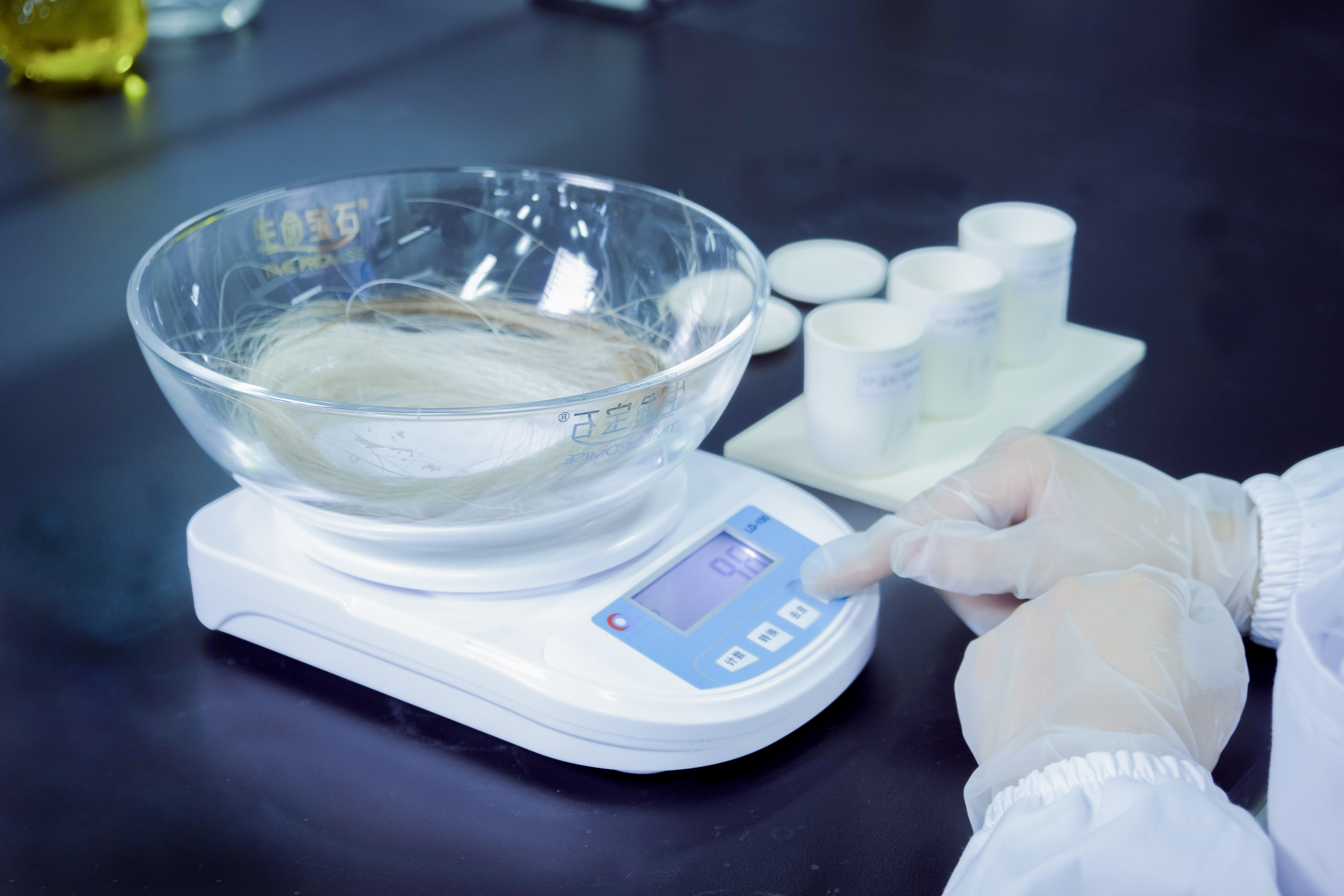
Memorial diamond synthesis applies the same HPHT scientific principles as industrial synthetic diamond manufacturing, but with additional constraints imposed by the biological carbon source. Human hair, pet fur, and botanical samples require purification and graphitization before they can serve as HPHT feedstock, as detailed in our carbon purity requirements analysis.
The key engineering difference is variability. Natural graphite used in standard synthetic diamond production is a controlled industrial material with consistent purity, particle size, and crystallinity. Biological carbon, even after purification and graphitization, exhibits batch-to-batch variation in these parameters. The memorial diamond manufacturer must therefore operate with wider process tolerances and more intensive quality control. For pet owners evaluating memorial diamond options, our Pet Memorial Diamond Buying Guide explains how these manufacturing variables affect the final product quality and what questions to ask suppliers.
One specific challenge is the smaller scale of memorial diamond production. Where industrial synthetic diamond operations may run 50+ cells simultaneously in continuous production, memorial diamonds are typically produced in smaller batches with each cell dedicated to a specific customer's material. This reduces economies of scale and increases unit cost, but it is the necessary cost of traceability and personalization. The engineering solution is to optimize cell loading efficiency, minimize turnaround time, and maximize first-pass yield to control cost without compromising the individual-batch model.
Conclusion: Science as the Foundation of Industrial Quality
Diamond manufacturing is not a craft or an art — it is a materials engineering discipline governed by thermodynamic phase boundaries, transport kinetics, and defect physics. The manufacturers who understand these scientific foundations produce more consistent crystals, higher yields, and better-quality final products. Those who treat synthesis as a black-box process subject to trial-and-error adjustment incur higher costs, lower yields, and unpredictable quality.
For B2B partners in the memorial diamond industry, this scientific foundation is a competitive advantage. The partner who can explain why 5 GPa matters, why catalyst chemistry affects color, and why growth rate controls inclusion density is the partner who earns customer trust and builds lasting relationships. The science is not merely an internal manufacturing concern — it is the basis of quality communication and brand differentiation. For partners evaluating supplier capabilities, our documented case studies show how these technical parameters translate into consistent commercial results across 1,800+ production cycles.
BioGem Lab operates on the principle that transparency in manufacturing science builds stronger partnerships. Our process parameters, quality controls, and batch documentation are available to partners who want to communicate technical credibility to their customers. The science belongs to the industry, and the industry grows when all participants operate from a shared understanding of how these extraordinary materials are created.
Frequently Asked Questions
What pressure and temperature are required for HPHT diamond synthesis?
Industrial HPHT diamond synthesis requires pressures of 5-6 GPa (50,000-60,000 atmospheres) and temperatures of 1,300-1,600°C. These conditions place the carbon feedstock within the diamond stability field of the carbon phase diagram, where diamond is the thermodynamically stable allotrope. The precise parameters depend on the catalyst system, capsule geometry, and desired growth rate.
What metal catalyst is used in HPHT diamond manufacturing?
The standard industrial catalyst is a nickel-manganese-cobalt (Ni-Mn-Co) alloy, typically in a 70:25:5 ratio. This alloy melts at approximately 1,250°C under synthesis pressure, dissolves carbon from the graphite feedstock, and transports it to the diamond seed crystal where supersaturation drives crystallization. Alternative catalysts include iron-based alloys, but Ni-Mn-Co remains dominant for gem-quality production due to its optimal carbon solubility and growth rate characteristics.
How long does HPHT diamond crystal growth take?
For industrial memorial diamond production, HPHT growth typically requires 7-21 days depending on target carat weight. A 0.5-carat diamond grows in approximately 7-10 days. A 1.0-carat diamond requires 14-18 days. Larger crystals (1.5-2.0 carat) may require 21-30 days. Growth duration is determined by the balance between growth rate (faster reduces cost but increases defect density) and crystal quality.
What causes inclusions in laboratory-grown diamonds?
Inclusions in HPHT-grown diamonds originate from three primary sources: (1) metallic inclusions from the catalyst solvent that become trapped during rapid growth, (2) graphite inclusions from incomplete conversion of the feedstock, and (3) voids or cracks from thermal stress during cooling. Growth rate is the dominant control parameter — faster growth increases supersaturation and traps more catalyst inclusions. Controlled, moderate growth rates minimize inclusion density.
How is diamond quality graded after HPHT synthesis?
After synthesis, raw diamonds are graded using the same 4Cs system applied to natural diamonds: Carat (weight), Color (absence of nitrogen or other color centers), Clarity (absence of inclusions and blemishes), and Cut (proportions and symmetry of the finished gem). For memorial diamonds, independent gemological laboratories (IGI or equivalent) provide certification that documents these parameters for end customers and B2B partners.
What is the difference between batch and continuous diamond manufacturing?
Batch manufacturing loads individual synthesis cells with carbon feedstock and a diamond seed, processes them for the full growth duration, then unloads and extracts the finished crystal. This is the standard method for memorial diamonds, where each batch corresponds to a specific customer's carbon sample. Continuous manufacturing, used in some industrial synthetic diamond production, attempts to maintain growth conditions indefinitely while periodically extracting diamonds and replenishing feedstock. Batch processing remains dominant for memorial diamonds because traceability and sample-specific handling are essential.
Li Lihua — Chief Scientist
Patent inventor ZL 201010565778.9. View profile →
Explore HPHT Technology
View detailed specifications of BioGem Lab's HPHT synthesis infrastructure, catalyst protocols, and temperature control systems for memorial diamond manufacturing.
Technology OverviewRelated Articles
Carbon Purity Requirements for Memorial Diamond Synthesis
Technical specifications for carbon feedstock purity in HPHT memorial diamond manufacturing: extraction yield, contamination thresholds, and quality control protocols.
Read article →Lab-Grown Diamond Manufacturing: Industrial Process Explained
A complete technical guide to industrial lab-grown diamond manufacturing from carbon purification through certification.
Read article →What Is HPHT Diamond Growth? A Technical Overview
Pressure fields, temperature gradients, metal catalyst transport, and crystal nucleation mechanics in industrial memorial diamond manufacturing.
Read article →