The transformation of carbon into diamond is one of the most demanding synthesis processes in materials engineering. At the atomic level, it requires rearranging carbon atoms from a two-dimensional hexagonal lattice (graphite, the thermodynamically stable form at ambient conditions) into a three-dimensional tetrahedral lattice (diamond, the metastable high-pressure allotrope) — and then stabilizing that metastable structure indefinitely.
TL;DR — Quick Summary
Carbon becomes diamond through a reconstructive phase transformation: atoms are rearranged from a two-dimensional hexagonal lattice (graphite) into a three-dimensional tetrahedral lattice (diamond) under extreme pressure and temperature. The HPHT process uses a metal catalyst to dissolve carbon from graphite and precipitate it onto a diamond seed crystal, producing a genuine gem in 18–25 days of sustained growth.
This article explains the complete carbon-to-diamond transformation as practiced in industrial memorial diamond manufacturing. We cover the physics of carbon bonding, the engineering of HPHT synthesis conditions, the kinetics of crystal formation, and the process validation protocols that ensure reproducible gem-quality output. For B2B partners and technical buyers, understanding these fundamentals is essential for evaluating manufacturing capability and communicating product authenticity to end customers.
The Physics of Carbon Allotropes: Why Structure Determines Properties
Carbon is unique among elements in its ability to form multiple stable allotropes with radically different physical properties. Understanding why graphite is soft, conductive, and black — while diamond is hard, insulating, and transparent — is the foundation of diamond synthesis engineering.
In graphite, carbon atoms bond covalently within two-dimensional sheets (sp² hybridization), with weak van der Waals forces between sheets. Each carbon atom has three in-plane σ-bonds and one out-of-plane π-bond. The π-electron system is delocalized, making graphite electrically conductive. The weak inter-sheet bonding makes graphite soft and lubricious — properties that make it useful as a lubricant but entirely unsuitable as a gemstone.
In diamond, every carbon atom forms four covalent bonds in a tetrahedral arrangement (sp³ hybridization), creating a continuous three-dimensional network. Each C–C bond has a length of 1.54 Å and a bond energy of 356 kJ/mol — among the strongest covalent bonds in any material. The isotropic bonding network gives diamond its extreme hardness (10 on the Mohs scale), high thermal conductivity, and optical transparency across the visible spectrum.
The energy difference between graphite and diamond is small — approximately 2 kJ/mol — which means diamond is only slightly less stable than graphite at standard temperature and pressure. However, the kinetic barrier to conversion is enormous. Converting graphite to diamond requires overcoming an activation energy of roughly 540 kJ/mol, which is why diamonds do not spontaneously revert to graphite under ambient conditions (the transformation is kinetically inhibited, not thermodynamically impossible).
Key Insight for Manufacturers: Diamond synthesis is not about "creating" carbon atoms — it is about forcing existing carbon atoms to rearrange from sp² to sp³ bonding under conditions where the thermodynamic equilibrium shifts toward diamond. The challenge is engineering those conditions reproducibly at industrial scale.
From Biological Carbon to Synthesis-Grade Feedstock
Memorial diamond manufacturing begins not with graphite but with biological carbon — typically keratin protein from hair or fur, which contains approximately 45–50% carbon by dry mass. The remainder is hydrogen, oxygen, nitrogen, sulfur, and trace minerals. Before this carbon can participate in diamond synthesis, it must be extracted, purified, and graphitized.
BioGem Lab's patented carbon extraction system (Chinese National Invention Patent ZL 201010565778.9) performs this conversion in three engineering stages:
2.1 Thermal Decomposition and Pyrolysis
Biological samples are heated in a controlled-atmosphere furnace to 800–1,000°C under oxygen-limited conditions. At these temperatures, organic molecules undergo pyrolysis: volatile elements (H, O, N, S) dissociate and exit as gas-phase products, leaving a carbon-rich char residue. Mass reduction is typically 85–90%, meaning 1 gram of hair yields approximately 100–150 mg of carbon char.
2.2 Chemical Purification
The char contains residual mineral salts (Ca, Na, Mg, Fe from biological tissues and environmental exposure) that must be removed to prevent contamination during HPHT synthesis. Acid leaching with controlled pH cycles dissolves mineral inclusions, followed by multiple deionized water rinses. Elemental analysis confirms carbon purity above 99.5% before the material proceeds to graphitization.
2.3 Process Validation at the Carbon Stage
Each extracted carbon batch undergoes infrared spectroscopy and thermogravimetric analysis (TGA). Residual nitrogen content is quantified because nitrogen acts as a dopant during diamond growth, producing yellow coloration. If nitrogen exceeds specification thresholds, additional purification cycles are applied. This quality gate is one reason BioGem Lab maintains consistent color outcomes across production batches — a critical capability for B2B white-label partners who need predictable product specifications.
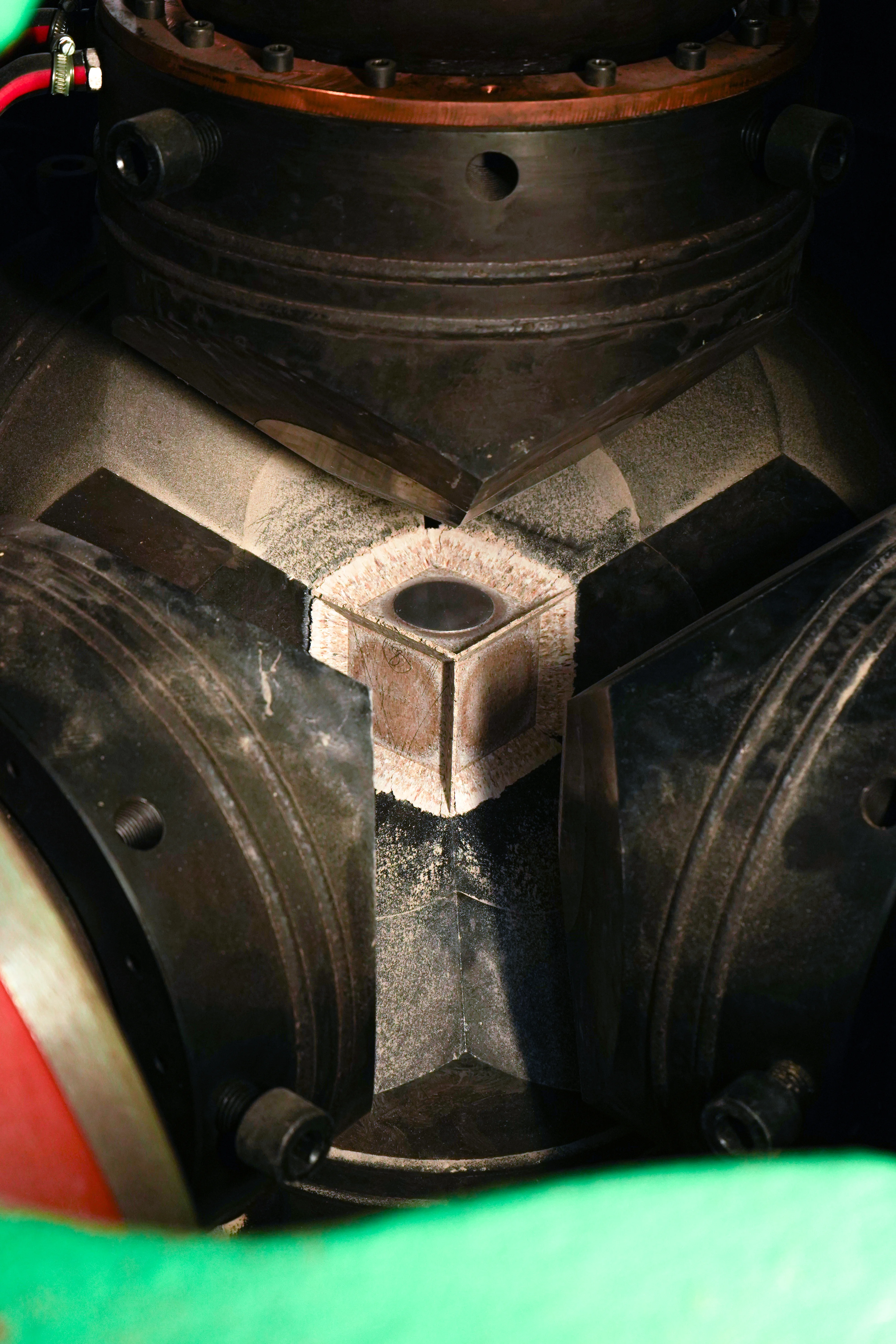
Figure 1: HPHT synthesis chamber — the core equipment where graphite transforms into diamond under 5–6 GPa and 1,300–1,600°C.
Graphitization: The Structural Bridge Between Amorphous Carbon and Diamond
Amorphous carbon — the black powder produced by extraction — cannot be used directly in HPHT synthesis. Diamond does not grow from disordered carbon; it grows from crystalline graphite where carbon atoms are already arranged in layered hexagonal sheets. The graphitization stage converts amorphous carbon into this ordered precursor structure.
Purified carbon powder is loaded into a graphitization furnace and heated to 2,600–3,000°C in an inert argon atmosphere. At these temperatures, carbon atoms acquire sufficient thermal energy to break and reform bonds, self-organizing into graphite's characteristic layered structure. The process takes 7–10 days depending on batch mass and furnace geometry.
The quality of graphitization is measured by two parameters: crystallite size (La) and degree of graphitization (g). Well-graphitized material (g > 0.85, La > 100 nm) dissolves readily in metal catalyst solvents during HPHT synthesis and produces uniform diamond growth. Poorly graphitized material (g < 0.60) dissolves irregularly, producing inclusions, color zoning, and growth defects. See our dedicated article on graphitization quality control for a deeper technical treatment of this stage.
HPHT Synthesis: Engineering the Diamond Stability Field
High-Pressure High-Temperature (HPHT) synthesis is the industrial process that replicates the thermodynamic conditions under which natural diamonds form in Earth's mantle. The Berman-Simon line, established in 1955, defines the pressure-temperature boundary above which diamond becomes thermodynamically favored over graphite: approximately 5 GPa at 1,300°C, rising to 6 GPa at 1,600°C.
BioGem Lab's HPHT presses operate within the belt-type or cubic-press configuration, using tungsten carbide anvils to compress cylindrical growth cells. The industrial process involves six controlled stages:
- Growth cell assembly — Graphite powder is loaded into a ceramic sleeve with a metal catalyst solvent (typically Fe-Ni-Co or Ni-Mn-Co alloy) and a small diamond seed crystal. The seed crystal provides the crystallographic template onto which new carbon atoms deposit.
- Press loading — The growth cell is centered between opposing anvils. Alignment precision is critical: off-center loading produces asymmetric pressure distributions that cause crystal deformation.
- Pressure ramp — Hydraulic systems compress the growth cell to 5–6 GPa (approximately 50,000–60,000 atmospheres). Pressure is monitored via calibrated strain gauges with ±0.1 GPa accuracy.
- Temperature ramp — Resistive heating brings the cell to 1,300–1,600°C. Temperature uniformity across the growth zone is maintained within ±25°C to prevent thermal stress cracking.
- Growth phase — The metal catalyst melts and dissolves graphite. Carbon atoms diffuse through the molten metal toward the cooler diamond seed, where they crystallize onto the existing lattice. Growth rates range from 0.5 to 2.0 mg/hour depending on temperature, pressure, and catalyst composition.
- Controlled cooldown — Temperature is reduced at a controlled rate (typically 50°C/hour) to prevent thermal shock. Pressure is released only after the cell has cooled below 400°C.
The raw diamond — called "diamond rough" — emerges as an octahedral or cuboctahedral crystal with an opaque, dark surface. The surface coloration comes from residual graphite and metal catalyst traces, not from the diamond's internal quality. Internal quality is revealed only after cutting and polishing.
Crystal Formation Kinetics: Controlling Growth Rate and Defect Density
Diamond crystal quality is governed by the interplay between supersaturation, growth temperature, and impurity concentration. These parameters determine whether the crystal grows with high clarity and uniform color — or with inclusions, dislocations, and color zoning.
Supersaturation refers to the degree to which the molten catalyst is overloaded with dissolved carbon relative to its equilibrium solubility. High supersaturation drives rapid growth but increases defect density because carbon atoms attach to the crystal lattice faster than they can find energetically favorable lattice positions. Low supersaturation produces slow, high-quality growth but extends production timelines. Memorial diamond manufacturers typically optimize for moderate supersaturation that balances growth rate with gem quality.
Temperature gradients within the growth cell create the driving force for carbon diffusion. The seed crystal is positioned at the cooler end of the cell; the graphite source at the hotter end. The temperature difference (typically 20–50°C across a 5 mm cell) must be stable throughout the 10–20 day growth period. Fluctuations in temperature gradient cause growth-rate variations that produce growth bands — visible under magnification as parallel lines in the crystal structure.
Impurity control is the final quality-determining factor. Nitrogen from incomplete carbon purification enters the diamond lattice as single substitutional atoms, producing yellow coloration. Boron produces blue; nickel produces green. For memorial diamonds, nitrogen management is the primary concern because biological carbon sources inherently contain nitrogen. BioGem Lab's purification and graphitization infrastructure is designed specifically to remove nitrogen before synthesis, enabling production of near-colorless memorial diamonds.
From Rough Crystal to Finished Gem: Cutting and Process Validation
Diamond rough is optically opaque and geometrically irregular. Transforming it into a brilliant gemstone requires precision cutting, faceting, and polishing — stages that represent approximately 30–40% of total production cost in memorial diamond manufacturing.
The process begins with 3D scanning and planning. A laser scanner maps the rough crystal's external morphology and internal inclusions. Software calculates the optimal cut that maximizes carat weight while achieving target proportions and clarity grade. For round brilliant cuts, the planner optimizes for the "ideal" proportions: table 53–57%, crown angle 34–35.5°, pavilion angle 40.6–41.0°.
Once planned, the rough is either sawn (using a diamond-impregnated blade or laser) or cleaved along natural crystal planes if multiple gems are to be produced from one rough. The remaining steps follow the traditional diamond cutting sequence: bruting (shaping the girdle outline), faceting (cutting the pavilion and crown facets at precise angles), and final polishing to optical clarity.
After cutting, each memorial diamond undergoes process validation through gemological grading and spectroscopic analysis:
- Grading report — China Gemstone Certificate assessing the 4Cs (Carat, Color, Clarity, Cut) under standardized lighting and magnification protocols.
- Traceability verification — CCIC National Traceability Certificate linking the finished diamond to the original carbon source, production batch, and laboratory records.
- Spectroscopic fingerprinting — Fourier-transform infrared (FTIR) spectroscopy confirms the diamond's lattice structure and distinguishes synthetic growth features from natural diamond signatures.
- Optional IGI certification — International Gemological Institute grading for partners requiring internationally recognized documentation for their markets.
Why This Matters for B2B Partners
Understanding the complete carbon-to-diamond transformation is not an academic exercise for memorial diamond resellers — it is a commercial necessity. Pet owners and grieving families ask detailed questions about how memorial diamonds are made. Partners who can explain carbon extraction, graphitization, HPHT synthesis, and quality validation in clear technical terms build trust and command premium pricing.
More importantly, the quality of the manufacturing process directly determines the quality of the final product. Memorial diamonds produced with suboptimal graphitization, unstable temperature control, or inadequate nitrogen removal will exhibit visible growth bands, inconsistent color, and lower clarity grades. These defects are permanent — they cannot be corrected in cutting. Selecting a manufacturer with robust process engineering and process validation protocols is therefore the single most important decision a memorial diamond reseller makes.
Explore OEM Memorial Diamond Manufacturing
BioGem Lab supplies white-label and OEM memorial diamonds to pet cremation services, veterinary clinics, and memorial brands worldwide. Our patented carbon extraction technology, HPHT synthesis infrastructure, and traceability certification system enable partners to offer memorial diamonds without manufacturing investment or inventory risk.
Frequently Asked Questions
How much carbon is needed to grow a 1-carat memorial diamond?
A 1-carat diamond contains approximately 0.2 grams of pure carbon. However, manufacturing yield accounts for losses during extraction (85–90% mass reduction), graphitization (negligible), cutting (30–60% mass loss depending on rough shape), and synthesis inefficiency. Approximately 6 grams of hair or fur provides sufficient carbon with appropriate safety margins for a 1-carat memorial diamond.
What pressure and temperature are required for diamond synthesis?
HPHT diamond synthesis requires approximately 5–6 GPa (50,000–60,000 atmospheres) of pressure and 1,300–1,600°C temperature. These conditions place the carbon system in the diamond stability field, above the Berman-Simon equilibrium line where diamond is thermodynamically favored over graphite.
How long does HPHT diamond growth take per carat?
Growth duration depends on crystal size, growth rate, and quality targets. Typical growth rates in industrial HPHT synthesis range from 0.5 to 2.0 mg per hour. A 1-carat (200 mg) diamond therefore requires approximately 100–400 hours of active growth time, typically scheduled as 18–25 days of continuous press operation.
Can any biological carbon source be used for diamond synthesis?
In principle, any carbon-rich biological material can be used. In practice, hair and fur are preferred because they are easy to collect, handle, and process. Pet nails and claws are also viable keratin sources when fur is unavailable. Botanical material (flowers, leaves) is feasible but generally yields less carbon per unit mass than keratin-based sources.
How do manufacturers verify that a memorial diamond genuinely contains the source carbon?
Traceability is maintained through chain-of-custody protocols: unique barcode tracking from sample receipt through extraction, graphitization, synthesis, cutting, and certification. BioGem Lab provides a CCIC National Traceability Certificate that links the finished diamond to the original source material. While atomic-level isotopic fingerprinting is theoretically possible, industrial traceability relies on process documentation and barcode-linked production records.
What causes color variations in memorial diamonds?
Diamond color is determined by lattice impurities and structural defects. Nitrogen produces yellow; boron produces blue; nickel produces green. In memorial diamonds, nitrogen is the primary variable because biological carbon sources contain protein-bound nitrogen. Incomplete purification or suboptimal graphitization leaves residual nitrogen that enters the diamond lattice during HPHT growth. Process validation at the carbon stage — specifically nitrogen quantification — is therefore essential for color control.
What is the difference between natural and synthetic diamonds at the atomic level?
At the atomic level, there is no difference. Both are pure carbon in the sp³ tetrahedral lattice. The distinction lies in growth history: natural diamonds formed over millions of years under mantle conditions and may contain mineral inclusions from the growth environment; synthetic diamonds formed over days or weeks in manufactured growth cells and may contain metal catalyst inclusions. Gemological laboratories distinguish them by growth morphology, inclusion types, and spectroscopic signatures — not by chemical composition.
About BioGem Lab
BioGem Lab is a B2B memorial diamond manufacturer operating from Luoyang Institute of Technology National University Science Park, China. Since 2012, our patented carbon extraction technology (ZL 201010565778.9) has powered memorial diamond production for partners worldwide. We supply white-label and OEM memorial diamonds to pet cremation services, veterinary clinics, memorial brands, and funeral enterprises worldwide. We do not sell directly to consumers.
Memorial Diamonds for Your Business
White-label production · Zero inventory · ~60-day turnaround
Li Lihua — Chief Scientist
Patent inventor ZL 201010565778.9. View profile →
Ready to Partner with BioGem Lab?
Learn about our white-label and OEM manufacturing programs for memorial diamond businesses.
Explore Partnership →