The color of a memorial diamond is not an aesthetic afterthought. It is the physical record of the chemical environment inside the HPHT synthesis chamber during crystal formation. Nitrogen traces from the biological carbon source, boron doping decisions made by the manufacturer, and the density and distribution of lattice defects in the growing crystal — each of these factors writes a specific signature into the diamond's optical properties. Understanding how they interact is essential for manufacturers, partners, and quality professionals who need to predict, control, and explain memorial diamond color outcomes.
This article is written from the manufacturing perspective. We describe the mechanisms that govern color formation in HPHT-synthesized memorial diamonds, the specific challenges introduced by biological carbon sources (as opposed to generic graphite feedstock), and the practical implications for quality control and partner communication. We do not offer consumer buying advice. We offer process knowledge.
Why Diamond Color Is a Materials Science Problem
A diamond is a cubic crystal lattice of carbon atoms. In its ideal form — a "type IIa" diamond — every lattice site is occupied by carbon, and the crystal is perfectly transparent across the visible spectrum. No real diamond achieves this perfection. Every natural and synthetic diamond contains impurities (atoms other than carbon) and defects (disruptions in the regular lattice structure). These impurities and defects absorb light at specific wavelengths, and the wavelengths that are absorbed determine the color the diamond appears to the human eye.
In mined diamonds, color is largely determined by the geological environment where the crystal formed over millions of years. In HPHT-synthesized memorial diamonds, color is determined by the manufacturing conditions over a period of days or weeks. The manufacturer has more control than nature, but the control is not absolute. The biological carbon source introduces variability that generic graphite does not, and the synthesis process itself is a complex system of interacting variables — temperature, pressure, catalyst composition, growth rate, and thermal gradient — that cannot be optimized independently for color alone.
Nitrogen: The Dominant Color Modifier in Memorial Diamonds
Nitrogen is the most common impurity in both natural and synthetic diamonds. It is also the most consequential for color. In the diamond lattice, nitrogen can exist in several structural configurations, each with a distinct optical signature. The type of nitrogen present — and its concentration — determines whether the diamond appears colorless, yellow, or brown.
Type Ia and Ib Nitrogen: Isolated vs. Aggregated States
Nitrogen exists in diamond in two primary forms: isolated substitutional atoms (type Ib) and aggregated pairs or clusters (type Ia). In type Ib diamonds, single nitrogen atoms replace carbon atoms in the lattice. These isolated nitrogen atoms create an electronic absorption band in the ultraviolet and blue regions of the spectrum, causing the diamond to absorb blue light and transmit yellow — the classic "cape yellow" color. The intensity of the yellow color is directly proportional to the nitrogen concentration in type Ib form.
Type Ia nitrogen occurs when nitrogen atoms pair up or form larger clusters (A-centers and B-centers). These aggregates do not absorb visible light and therefore do not cause yellow coloration. They do, however, absorb in the infrared. The transition from type Ib to type Ia nitrogen — a process known as nitrogen aggregation — is temperature-dependent. In natural diamonds, this aggregation occurs over geological timescales at mantle temperatures. In HPHT synthesis, the same aggregation can be induced or accelerated by the high temperatures of the growth process itself.
The Nitrogen Problem in Biological Carbon
The specific challenge for memorial diamond manufacturing is that biological carbon sources — hair, fur, plant fibers — are inherently nitrogen-rich. Keratin, the protein that makes up hair and fur, contains approximately 14–18% nitrogen by mass. Plant cellulose contains less nitrogen but still carries measurable amounts from amino acid residues and environmental uptake. When biological carbon is purified and converted to graphite for HPHT synthesis, not all nitrogen is removed. Residual nitrogen in the carbon feedstock enters the crystal lattice during growth and manifests as color.
The nitrogen concentration in the final diamond depends on three factors: the efficiency of the carbon purification process (how much nitrogen is removed before synthesis), the growth conditions (temperature and pressure profiles that influence nitrogen incorporation rates), and the growth time (longer growth periods allow more nitrogen to enter the crystal). A manufacturer using high-purity graphite feedstock has predictable, low nitrogen levels. A manufacturer using biological carbon must manage variable nitrogen inputs and design the synthesis process to accommodate them.
At BioGem Lab, our proprietary carbon purification process, protected under Chinese national invention patent ZL 201010565778.9, is specifically designed to reduce nitrogen content in biological carbon to levels compatible with colorless and near-colorless diamond synthesis. The purification involves multiple stages of controlled oxidation and thermal treatment that decompose nitrogen-containing organic compounds before graphitization. This is not generic carbon purification; it is a process engineered for the specific chemical composition of biological materials.
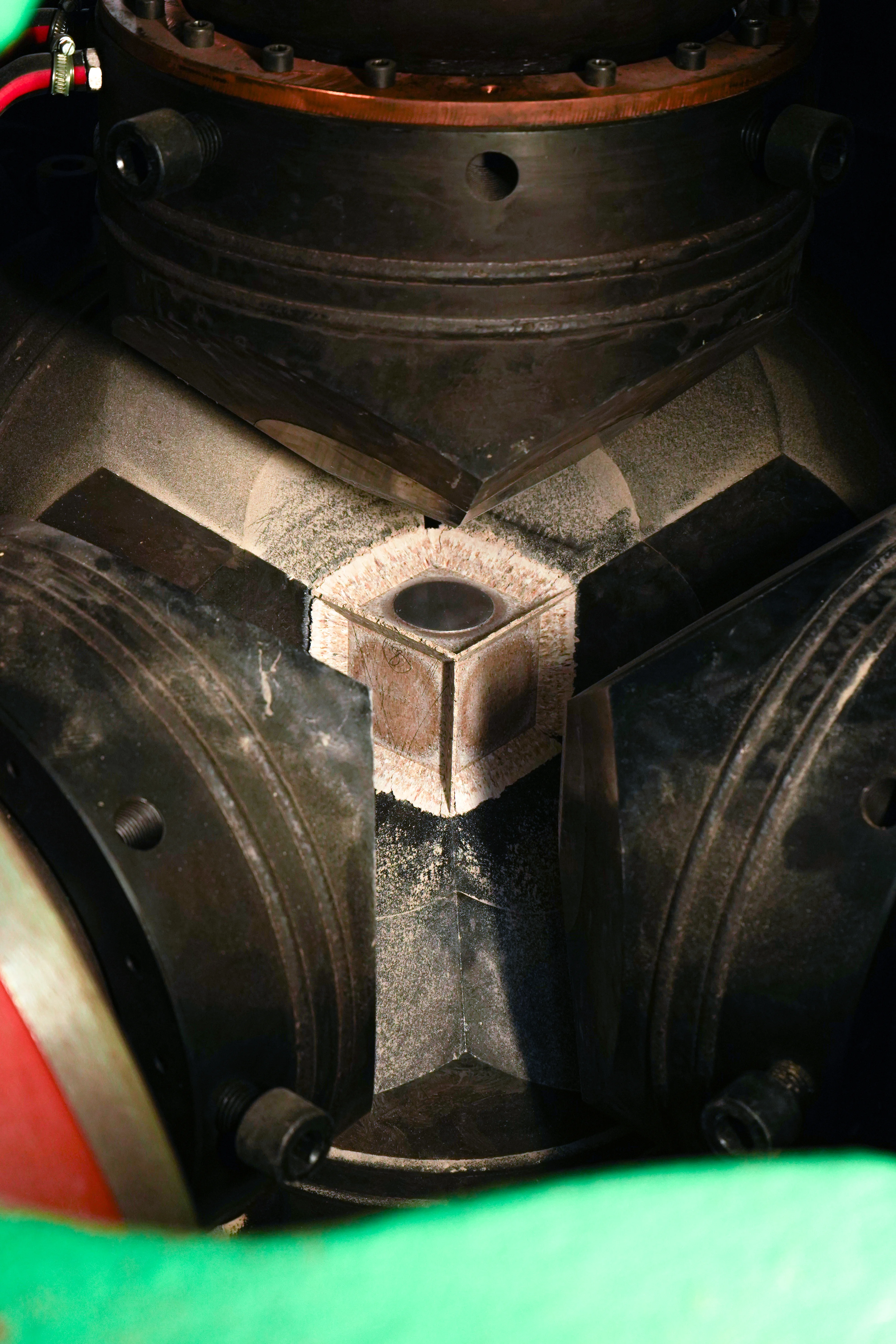
HPHT synthesis chamber at operating conditions. The temperature and pressure profile inside the growth cell directly influence nitrogen incorporation and aggregation states.
Boron: The Blue Color Agent
Boron is the second most important impurity for memorial diamond color. Unlike nitrogen, which is usually an unwanted contaminant from the carbon source, boron is typically introduced intentionally by the manufacturer as a dopant. Boron-substituted diamonds (type IIb) absorb light in the red and infrared regions, causing the diamond to transmit blue. The concentration of boron determines the intensity of the blue color, from barely perceptible sky blue to deep, saturated blue.
Boron Doping in HPHT Synthesis
In HPHT synthesis, boron is introduced through the metal catalyst solvent. The catalyst — typically a nickel-iron or nickel-manganese-cobalt alloy — is the medium through which carbon dissolves, diffuses, and precipitates onto the diamond seed. By adding boron to the catalyst in controlled quantities, the manufacturer can create a boron-rich environment in the growth cell that leads to boron incorporation into the growing crystal.
The mechanism is temperature-dependent. Boron has a higher distribution coefficient than nitrogen in the diamond lattice, meaning it is incorporated more readily at typical HPHT growth temperatures (1,300–1,600°C). However, boron incorporation also competes with nitrogen incorporation. In a growth environment with high nitrogen availability, boron doping must be increased to achieve the desired blue color, because nitrogen absorption in the blue-yellow region can partially cancel the blue color produced by boron absorption in the red region. The result is a complex color balance that requires precise control of both dopants.
Why Some Memorial Diamonds Are Blue by Design
Blue is the second most common color request for memorial diamonds, after colorless. The preference for blue has a clear rationale: blue is associated with calm, memory, and permanence. It is also a color that is difficult to achieve accidentally — a yellow hue is almost certainly the result of nitrogen content, which signals manufacturing control to the end customer.
From a manufacturing perspective, blue memorial diamonds are more predictable than colorless ones because the boron dopant overwhelms the variable nitrogen signal. A boron-doped type IIb diamond will be blue regardless of whether the nitrogen concentration is 1 ppm or 10 ppm, as long as the boron concentration is sufficiently high (typically >0.2 ppm). Colorless diamonds, by contrast, require all color-causing impurities to be minimized simultaneously — a much stricter constraint.
The trade-off is that boron-doped diamonds are electrically conductive (type IIb diamonds are semiconductors), which can affect some post-growth processing steps and may be relevant for partners who plan to offer specialized setting or mounting options. The conductivity is not a quality issue; it is a materials property that informed partners should understand.
Lattice Defects: Color from Structure, Not Chemistry
Not all color in diamonds comes from chemical impurities. Some color — particularly brown and gray tones — comes from structural defects in the crystal lattice itself. These defects are not atoms; they are disruptions in the regular arrangement of carbon atoms that alter how light travels through the crystal.
Plastic Deformation and Brown Coloration
Brown color in diamonds is caused by plastic deformation — permanent mechanical distortion of the crystal lattice. This deformation creates dislocations, which are line defects where the regular stacking of atomic planes is disrupted. Dislocations scatter light across the visible spectrum, with a preference for shorter (blue) wavelengths, resulting in a brownish or brownish-yellow appearance.
In mined diamonds, plastic deformation occurs during the geological transport of diamonds from the mantle to the surface — the violent journey through kimberlite pipes. In HPHT-synthesized diamonds, plastic deformation is not caused by mechanical stress but by thermal stress. Rapid temperature changes during growth or cooling can create thermal gradients inside the crystal that exceed the elastic limit of the diamond lattice, causing dislocation formation. The larger the crystal and the faster the temperature change, the more severe the deformation and the more pronounced the brown color.
For memorial diamonds, this has a practical implication: large crystals are harder to grow without brown coloration. A 0.5-carat colorless memorial diamond is relatively straightforward. A 1.0-carat colorless memorial diamond requires more careful control of the thermal profile. A 2.0-carat colorless memorial diamond requires both excellent purification (to control nitrogen) and excellent thermal management (to prevent deformation). This is why larger memorial diamonds command disproportionately higher prices — the manufacturing difficulty increases non-linearly with size.
Vacancies and Gray Coloration
Another class of lattice defect is the vacancy — a missing carbon atom in the lattice. Isolated vacancies do not cause visible coloration. However, when vacancies combine with nitrogen atoms to form nitrogen-vacancy (NV) centers, they create a characteristic pink or red coloration. NV centers are the basis of quantum sensing and quantum computing applications, but in the context of memorial diamonds, they are usually an unwanted byproduct of growth conditions that favor vacancy formation over perfect lattice growth.
Gray coloration in diamonds is typically caused by a high density of unpaired vacancies or complex defect clusters that scatter light non-selectively. Gray diamonds appear murky or cloudy rather than vividly colored. Gray is generally considered an undesirable color in gem-quality diamonds, and its presence indicates growth conditions that were suboptimal for optical clarity.
The Interaction Problem: Why Color Control Is Hard
The color of a memorial diamond is not determined by any single factor. It is the result of interactions between nitrogen concentration, nitrogen aggregation state, boron doping level, vacancy density, dislocation density, crystal size, and growth conditions. These factors do not operate independently. Increasing the growth temperature to reduce brown coloration may increase nitrogen aggregation (reducing yellow) but also increase boron incorporation (deepening blue). Adding boron to achieve blue color may interact with residual nitrogen in ways that shift the final color toward green or gray rather than pure blue.
This interaction complexity is why memorial diamond color is not fully predictable from the manufacturing parameters alone. Even with identical purification protocols and growth conditions, two runs from the same biological carbon source may produce slightly different color outcomes because of minor variations in the carbon chemistry, catalyst behavior, or thermal uniformity in the growth cell. Experienced manufacturers develop empirical color distributions from their production data and communicate these distributions to partners rather than promising exact colors.
Color Grading for Memorial Diamonds: Practical Standards
Memorial diamonds are graded using the same color scales as mined and jewelry-grade lab-grown diamonds. The GIA color scale for near-colorless diamonds ranges from D (completely colorless) to Z (noticeable yellow or brown). For fancy-colored diamonds (blues, pinks, yellows with strong saturation), a separate "fancy" color grading system applies that describes hue, tone, and saturation.
What Partners Should Communicate to End Customers
For B2B partners, the most important color message is not the specific grade but the range of possibility. Memorial diamonds made from biological carbon will generally fall in the near-colorless to light yellow range (GIA J–M) unless the manufacturer has invested in advanced purification. Blue memorial diamonds are intentional doping outcomes. Deeply saturated colors (intense blue, vivid yellow) are rare and expensive. Most memorial diamonds are subtle in color — a slight warmth or a soft blue tint — and this is normal, not a quality defect.
Partners should also understand that the color of a memorial diamond is not a measure of the "quality" of the carbon source. A yellow memorial diamond does not mean the carbon was "impure." It means the nitrogen in the biological carbon was not fully removed during purification, which is a manufacturing outcome, not a source quality issue. The end customer's hair or fur was not "less good" because the resulting diamond is J color rather than D color. This distinction matters for customer communication and expectation management.
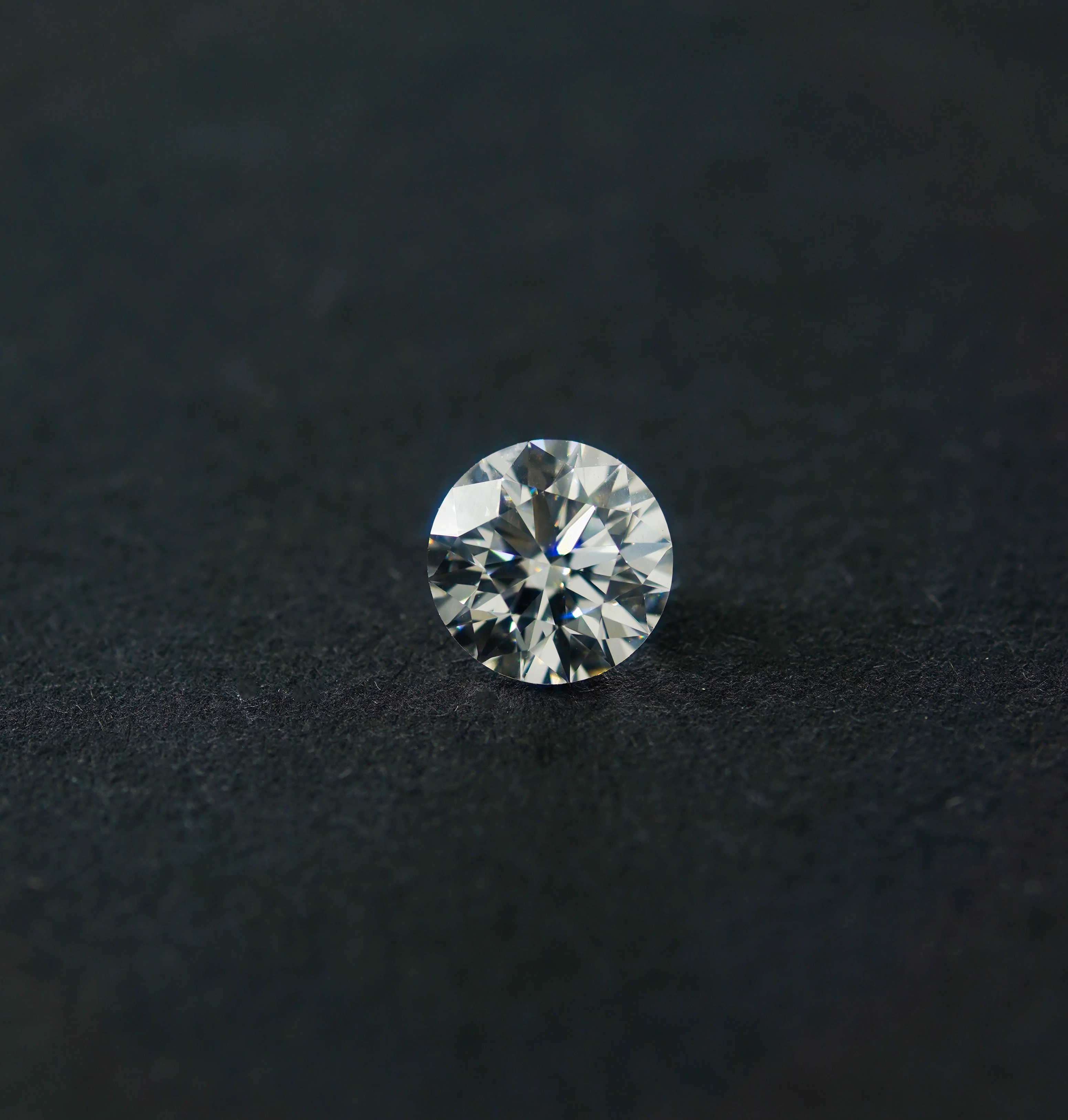
Single brilliant-cut memorial diamond under standardized grading light. Color assessment requires controlled conditions and experienced evaluation.
Manufacturing Quality Control for Color
Color control in memorial diamond manufacturing requires quality control at three stages: pre-synthesis carbon analysis, in-process growth monitoring, and post-synthesis optical characterization.
Pre-synthesis carbon analysis: The purified carbon should be tested for residual nitrogen content using elemental analysis (CHNS analysis). This provides a quantitative input for predicting the nitrogen-related color component. If nitrogen content is higher than expected, the purification process can be extended or the growth parameters adjusted to compensate.
In-process growth monitoring: HPHT growth cells can be instrumented with thermocouples and pressure sensors to track the actual conditions experienced by the growing crystal. Deviations from the target temperature profile can be corrected in real time or used to adjust the growth duration. Some manufacturers also use in-situ optical monitoring to detect color changes during growth, though this is technically challenging and not yet standard practice.
Post-synthesis optical characterization: After the rough crystal is removed from the growth cell, it should be examined under standardized grading light (D65 daylight simulator, 6,500 K color temperature) to assess body color. Advanced characterization may include UV-Vis spectroscopy to identify the specific absorption bands responsible for the color, which provides diagnostic information about the nitrogen and boron states in the crystal. This spectroscopic data is valuable for process improvement and for building the empirical color prediction models that guide future production.
What the Color of a Memorial Diamond Actually Means
The color of a memorial diamond is not arbitrary. It is a physical record of the manufacturing process that created it. A slightly yellow memorial diamond tells you that the biological carbon contained nitrogen, that the purification process reduced but did not eliminate it, and that the growth conditions favored type Ib nitrogen over aggregated forms. A blue memorial diamond tells you that the manufacturer intentionally doped the growth environment with boron and that the boron concentration was sufficient to produce visible color. A colorless memorial diamond tells you that the purification was highly effective, the growth thermal management was precise, and the crystal formed with minimal lattice defects.
For partners, the value of this knowledge is twofold. First, it enables accurate customer communication. A partner who can explain that a J-color memorial diamond is the result of residual nitrogen in the biological carbon, not a manufacturing error, can manage customer expectations more effectively than one who treats color as a mysterious quality attribute. Second, it enables informed supplier evaluation. A partner who understands color science can ask potential manufacturers the right questions about purification, doping, and quality control — and can interpret the answers to assess technical capability.
At BioGem Lab, we provide partners with detailed color characterization data for every production batch, including spectroscopic analysis when requested. We believe transparency about color mechanisms builds trust more effectively than vague claims about "perfect" results. The memorial diamond industry is a technical manufacturing field, and the manufacturers who treat it as such — who invest in analytical capability, process control, and partner education — will deliver the most consistent long-term outcomes.
Frequently Asked Questions
Why are some memorial diamonds yellow?
Yellow color in memorial diamonds is caused by nitrogen impurities from the biological carbon source. Hair and fur contain nitrogen-rich proteins (keratin), and residual nitrogen that remains after purification enters the diamond lattice during HPHT synthesis, absorbing blue light and producing a yellow appearance. Advanced purification can reduce this effect but rarely eliminates it entirely.
Can memorial diamonds be blue?
Yes. Blue memorial diamonds are produced by intentional boron doping during HPHT synthesis. Boron is added to the metal catalyst solvent, and it incorporates into the diamond lattice during growth, creating type IIb diamonds that absorb red light and transmit blue. Blue is more predictable than colorless because the boron signal overwhelms variable nitrogen content.
Does the color of a memorial diamond indicate quality?
Color is a materials property, not a quality judgment. A yellow memorial diamond is not "lower quality" than a colorless one — it simply reflects different nitrogen content in the carbon source and different purification outcomes. Quality is better assessed by clarity, cut precision, and structural integrity than by color grade alone. Partners should communicate this to end customers to manage expectations.
Why is color control harder for larger memorial diamonds?
Larger crystals require longer growth times and more complex thermal management. Longer growth periods allow more nitrogen to incorporate into the lattice. Larger crystals experience more severe thermal gradients, which can cause plastic deformation (brown coloration) and lattice defects. The manufacturing difficulty for colorless or near-colorless results increases non-linearly with crystal size.
Li Lihua — Chief Scientist
Patent inventor ZL 201010565778.9. View profile →
Explore Memorial Diamond Manufacturing
Technical capabilities, production timelines, and partnership structures for pet cremation services and memorial brands.
Related Articles
Doping and Color Control
How nitrogen, boron, and lattice defects determine memorial diamond color — and why BioGem Lab targets E–H only.
Carbon Source Purity
How biological carbon extraction and purification directly determine memorial diamond color and clarity.
What Is HPHT Diamond Growth?
The HPHT process explained: how temperature, pressure, and catalyst composition control diamond properties.