Quick Answer
A BioGem Lab memorial diamond B2B partnership runs five phases: (1) mutual NDA execution and partner qualification (3-7 business days), (2) sample collection and international logistics (5-10 days to our Luoyang laboratory), (3) carbon extraction, HPHT synthesis, and cutting (~35-45 days), (4) grading, certification, and white-label packaging (3-5 days), and (5) insured delivery plus ongoing partner support (3-7 days transit). Total standard cycle: 60 days from sample receipt. Minimum sample: 6 grams of hair or fur. Default certification: CCIC or ILDA, with IGI/GIA upgrades available. Every step follows our patented carbon extraction methodology (Patent No. ZL 201010565778.9), and no BioGem Lab branding appears on customer-facing materials unless the partner requests it.
| Phase | What happens | Typical duration |
|---|---|---|
| 1. NDA + qualification | Mutual non-disclosure agreement executed; B2B Partner Pack released | 3-7 business days |
| 2. Sample + logistics | Sample collected per protocol; express shipment to Luoyang laboratory | 5-10 days in transit |
| 3. Production | Carbon extraction and purification (7-15d) → HPHT synthesis (10-15d) → cutting and polishing (10-15d) | 35-45 days |
| 4. Grading + packaging | Grading, certification, white-label packaging assembly | 3-5 days |
| 5. Delivery + support | Insured express delivery; rebate tracking; remake policy | 3-7 days transit |
Introduction: The Question Behind the Question
Most articles about memorial diamonds focus on the science — HPHT pressure, carbon purity, crystal lattice formation. That information is valuable, but it answers a different question than the one our partners actually ask.
The question we hear most often is simpler: "What happens after we sign the NDA?" Not "how does HPHT work," but "when do I send the sample, how do I track it, what does my customer receive, and what happens if something goes wrong?"
This article is an end-to-end map of a memorial diamond B2B partnership — from the first legal document to the day the finished diamond arrives at your door. It is based on our operational experience with partners across 14+ countries, and it reflects the actual process we use today, not a theoretical workflow.
If you are evaluating whether memorial diamonds fit your service line — whether you run a pet cremation business, a jewelry brand, or a funeral home — this is the operational reality you need to understand.
Phase 1: Mutual NDA and Qualification
Every partnership at BioGem Lab begins with a mutual non-disclosure agreement. This is not a formality. The NDA protects both parties: you protect your customer relationships and brand positioning; we protect our carbon extraction protocols, production parameters, and wholesale pricing structure.
What the NDA covers:
- Carbon extraction and graphitization methodology
- Wholesale pricing tiers and volume rebate schedules
- Partner customer lists and territorial positioning
- Production facility details and capacity data
What the NDA does NOT do:
- Grant exclusive territorial rights — those are negotiated separately, after a successful trial order
- Commit either party to a minimum purchase volume
- Transfer any intellectual property
After the NDA is executed, we release the B2B Partner Pack — a single-document overview covering company credentials, product specifications, the carbon pre-extraction option, wholesale pricing, value-added services, partnership terms, volume rebates, customs compliance guidance, and next steps. The pricing tables and rebate schedules are confidential and remain bound by the NDA.
Typical timeline
NDA execution takes 3-7 business days, depending on legal review on the partner side.
Phase 2: Sample Collection and Logistics
Once the NDA is in place, the operational clock starts. The partner collects the biological sample from the end customer and arranges shipment to our laboratory in Luoyang, China.
Sample requirements by source type:
| Carbon source | Minimum | Recommended |
|---|---|---|
| Human hair / pet fur | 6 g | 10-20 g |
| Feathers | 10 g | 20-30 g |
| Plant fibers | 15 g | Species-dependent; larger quantities advised |
| Solid keratin (nails, shells) | 10 g | 20 g |
| Cremated remains | Not accepted — carbon content is insufficient for synthesis | |
Accepted sources include human hair, pet fur (cat, dog, rabbit, horse, and other mammals), feathers, plant fibers, and solid keratin. Cremated remains, urn residue, and cremated bone fragments are permanently excluded — modern cremation volatilizes the organic carbon that synthesis requires.
Logistics protocol:
We do not ship physical collection kits to new partners. Instead, we provide detailed digital collection instructions that the partner can forward to the end customer or print locally. This eliminates cross-border shipping delays and reduces cost. The customer self-sources equivalent tools: sealed bags, a basic digital scale, and protective packaging.
For sample shipment to China:
- Carrier: DHL Express or FedEx International Priority (USPS not recommended)
- Packaging: Triple-barrier standard — waterproof outer label, sealed inner bag, rigid mailer
- Documentation: Written declaration specifying sample type, species, and intended use ("for in vitro laboratory use only")
- Insurance: Covered under the partner's shipment arrangement; we insure the return journey
A note on pre-carbonization
For partners in regions with strict biosecurity regulations, we offer a carbon pre-extraction option. There are two cooperation routes. Under the light pre-treatment route — the option we recommend — the partner performs only initial stabilization: removing dust, sand, and solid inorganic impurities per our written protocol, then ships the pre-treated material to our laboratory. Because some carbon is lost during pre-treatment, the sample quantity should be approximately 1.5× the standard requirement. We then perform the full secondary carbonization, purification, and graphitization in-house.
Under the pre-carbonized powder route, the partner ships refined carbon powder (HS 38011000.90) rather than raw biological material, which bypasses many customs restrictions while preserving the memorial connection. This route demands strict purity standards (99.99%, with complete graphitization), adds laboratory verification time before production can start, and carries safety risks if the powder is improperly processed — which is why we recommend the light pre-treatment route for most partners. In both cases, our full secondary purification and graphitization quality controls still apply, and synthesis pricing is unchanged.
Typical timeline
Sample receipt at our laboratory within 5-10 days of partner shipment, depending on origin.
Phase 3: Carbon Extraction and Production
When the sample arrives at our facility, it is logged, photographed, and assigned a unique internal tracking code. This code follows the material through every stage of production.
Step 1: Carbon extraction and purification (7-15 days)
The biological material undergoes proprietary carbon extraction. The process removes organic impurities, isolates elemental carbon, and purifies it to 99.95%+ purity. This is the core of our patented methodology (Patent No. ZL 201010565778.9). The extracted carbon is then converted to graphite — the necessary crystalline precursor for diamond synthesis.

Step 2: HPHT synthesis (10-15 days)
The graphite is placed in a six-sided anvil press growth chamber and subjected to approximately 5.5 GPa of pressure and 1,450°C. Under these conditions, carbon atoms rearrange into diamond lattice structures. This is the same physical process that occurs in the Earth's mantle, compressed into a matter of days rather than millions of years.
HPHT growth is not a "set and forget" process. Our technicians monitor pressure stability, temperature gradients, and catalyst saturation daily. Crystal growth rate varies based on the specific carbon source — hair from different individuals or species behaves slightly differently due to inherent trace impurities. These variations are normal and expected; they are also what give each memorial diamond its unique characteristics.
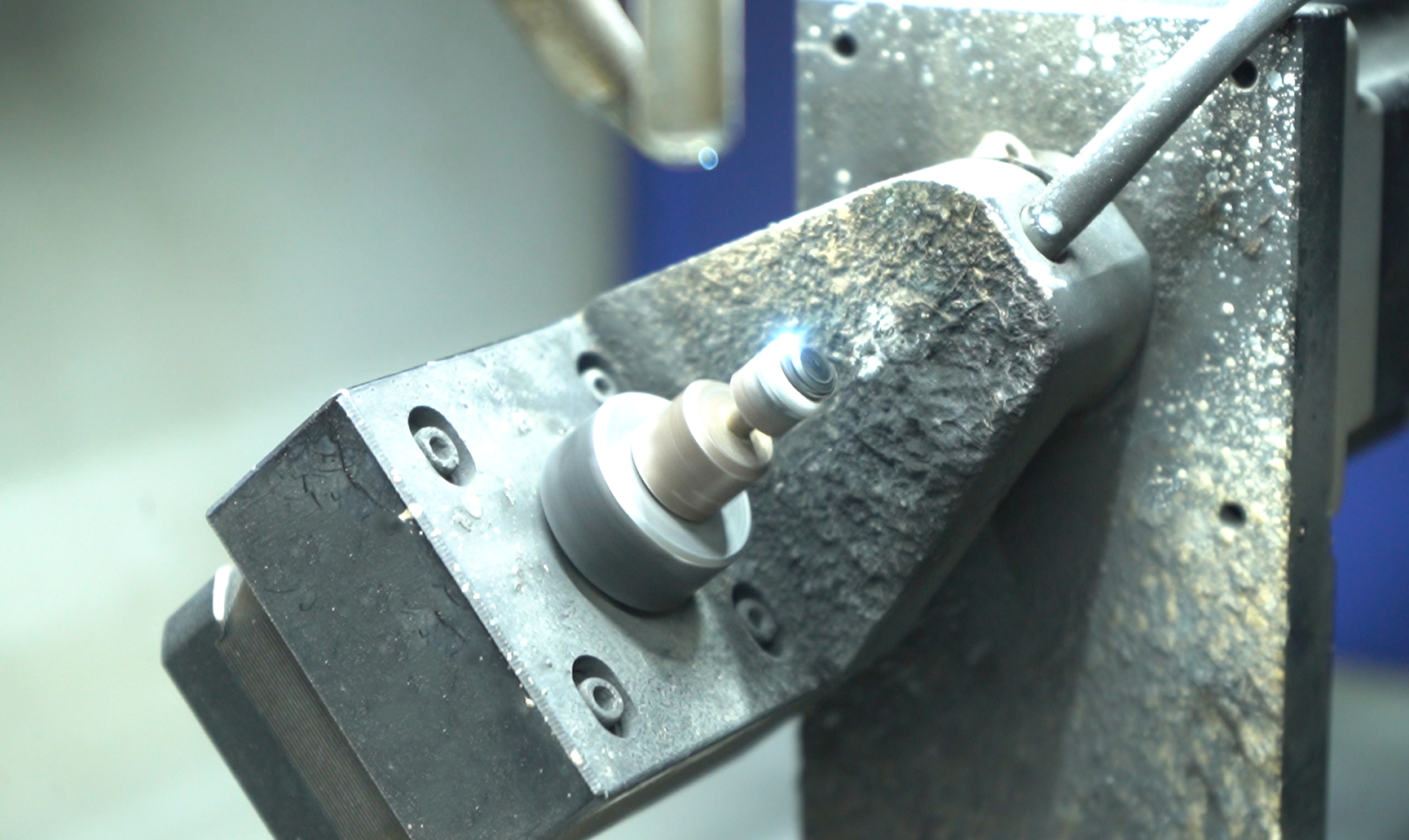
Step 3: Cutting and polishing (10-15 days)
Once the rough crystal is grown, it is cut and polished to the specified shape at our manufacturing facility. Standard production uses round brilliant Ideal cut. Optional shapes — Cushion, Emerald, Oval, Pear, Heart — are available at no significant cost premium, though production scheduling may vary.
Important note on process documentation
The HPHT synthesis chamber is fully sealed and operates at extreme temperature and pressure. It is not possible to photograph or video the interior during growth. We provide photographic documentation of the carbon extraction, inspection, cutting, and packaging stages. For partners requiring enhanced traceability, we offer individual sample isolation protocols and stage-by-stage photographic records where physically feasible.
Typical timeline
From sample receipt to rough crystal completion: approximately 35-45 days.
Phase 4: Grading, Certification, and White-Label Packaging
After cutting and polishing, each diamond undergoes grading and certification. The standard production specification is E-H color and VVS-SI clarity, in line with our OEM manufacturing standards.
| Certification level | Issuer | Cost | Additional time |
|---|---|---|---|
| Standard (included) | CCIC gemological certificate or ILDA certificate | Included in wholesale price | — |
| Upgrade option | IGI full grading report | Quoted per order — confirmed in the PI | +5-7 days |
| Upgrade option | GIA grading report | Quoted per order — confirmed in the PI | +10-14 days |
Critical policy on certificates:
Official gemological certificates (CCIC, IGI, GIA) are issued in the laboratory's standard format. They cannot be customized with partner logos or branding. White-label branding applies to the certificate card sleeve, packaging, documentation inserts, and shipping materials — not to the certificate itself.
White-label packaging:
Unless the partner requests otherwise, no BioGem Lab branding appears on any customer-facing material. Standard white-label delivery includes:
- Velvet presentation box (partner-branded sleeve or custom design)
- Certificate card sleeve (partner-branded)
- Care and maintenance documentation (partner-branded)
- Unique tracking code for ILDA third-party traceability lookup
White-label minimums: certificates can be branded in sleeves from 5 units; custom-branded packaging runs from 100 sets. The first order itself has no minimum — one stone is sufficient to validate the full workflow.
Typical timeline
Grading and packaging: 3-5 days.
Phase 5: Delivery and Ongoing Support
The finished diamond is shipped from our facility to the partner's designated address.
Delivery terms:
- Price includes international shipping and full insurance (110% of invoice value)
- Carrier: DHL Express or FedEx International Priority
- Transit time: 3-7 days to most destinations
- Export compliance: Finished laboratory-grown diamonds ship under HS 7104.90. Lab-grown diamonds are exempt from export controls and do not require a Kimberley Process certificate.
- Import duties and VAT: Responsibility of the partner (varies by jurisdiction)
Payment structure:
- New partners: 100% prepayment before production begins
- Mature partners (12+ months): Net-30 terms available after credit review
After delivery:
- Returns: Not accepted except for manufacturing defects (covered by production warranty)
- Color tolerance: If the finished stone deviates by more than one color grade from the agreed specification, we remake at no charge
- Annual volume rebates: tiered percentage credits applied as invoice credits in the following fiscal year — thresholds and rates are defined in the partner agreement
Jewelry assembly (optional):
For partners offering finished jewelry rather than loose stones, we provide ring, pendant, and earring assembly in 18K gold or PT950 platinum. Total delivery timeline extends to approximately 90 days (60 days for the diamond + 30 days for design, casting, and setting). Jewelry designs must be confirmed by day 45 of the diamond production cycle to avoid delays.
What Partners Actually Worry About (FAQ)
What if the sample gets lost in transit?
We recommend partners insure the sample shipment at full replacement value. If a sample is lost before reaching our facility, the partner bears the cost of recollection. Once the sample is in our possession, it is covered by our facility insurance until delivery.
Can my customer track the production process in real time?
Not in real time. The HPHT synthesis chamber is sealed and operates at 1,450°C — no camera can survive inside. We provide stage-by-stage photographic records of every step that is physically accessible: sample logging, carbon extraction, rough crystal inspection, cutting, grading, and packaging. The unique tracking code allows the end customer to verify authenticity through the ILDA third-party platform.
What happens if the carbon extraction fails?
With proper sample quantity (6g minimum, 10-20g recommended) and correct storage, extraction failure is extremely rare. If it does occur — typically due to sample contamination or insufficient carbon content — we notify the partner immediately and request a replacement sample. No charge is applied for the failed attempt; the partner pays only for the successful production run.
How do I explain the 60-day timeline to a grieving customer?
Transparency works better than speed claims. We recommend: "Your pet's sample undergoes a multi-stage laboratory process — carbon extraction, purification, crystal growth under extreme pressure and heat, precision cutting, and independent grading. Each stage requires time to ensure the result meets gemological standards. The 60-day timeline reflects the complexity of the science, not a delay."
Can I get exclusive rights for my country?
Territorial exclusivity is available after a successful trial order and proven volume commitment. We structure exclusivity as a tiered agreement: defined geographic area + minimum annual unit volume + review points. We do not grant exclusivity during the NDA or trial phase.
What if my customer wants a smaller diamond than 0.5 carats?
Technically feasible, but not recommended. The HPHT growth cycle for a 0.2-0.3ct stone is nearly identical to a 0.5ct stone (30-35 days vs. 35-40 days), but the fixed costs — certification, logistics, handling — do not scale down. The result is poor value for the end customer. We recommend directing customers toward 0.5ct as the practical minimum.
Do you handle cremated ashes?
No. Modern cremation processes completely volatilize organic carbon. The residual ash consists primarily of calcium compounds with insufficient carbon content for diamond synthesis. We accept hair, fur, feathers, plant fibers, and solid keratin (nails, shells). This is a permanent policy, not a temporary limitation.
Conclusion
A memorial diamond partnership is not a transaction. It is a structured operational relationship that spans legal qualification, international logistics, precision manufacturing, and ongoing quality assurance.
The partners who succeed with this product line are not the ones who understand diamond physics best. They are the ones who understand the operational workflow well enough to set accurate expectations with their customers, manage the 60-day timeline confidently, and communicate the value of a scientifically grounded memorial product.
If you are ready to evaluate a partnership, the first step is the same for everyone: execute the mutual NDA, review the B2B Partner Pack, and schedule a trial order. There is no minimum volume for the first order. One stone is enough to validate the full workflow. Explore our partnership programs →
Li Lihua — Chief Scientist
Patent inventor ZL 201010565778.9. View profile →
Start Your Memorial Diamond Partnership
Request a free OEM consultation — we reply within 24 hours. White-label HPHT memorial diamond production for pet cremation services and memorial brands. ~60-day standard turnaround.
Related Articles
OEM Memorial Diamond Manufacturing
How white-label memorial diamond manufacturing works — specifications, quality standards, and packaging options for B2B partners.
Cross-Border OEM Partnerships
What three real cross-border memorial diamond deals taught us about NDA structures, trial orders, and white-label supply chains.
Sample Requirements Explained
How much biological material is needed for a memorial diamond — and why cremated ashes cannot be used as a carbon source.